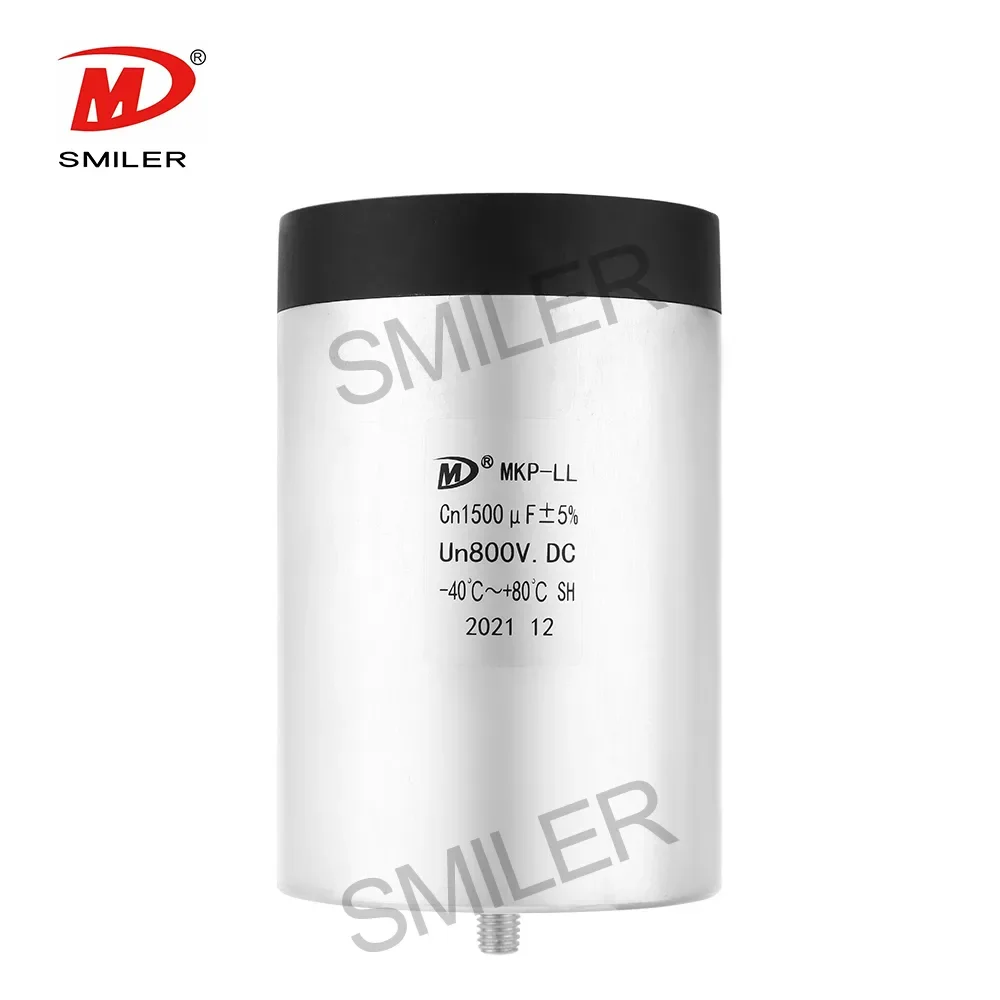
When you're designing a power converter, the film capacitor vs electrolytic capacitor decision shapes everything from heatsink size to warranty terms. Aluminum electrolytics still dominate low-cost DC links, but metallized polypropylene film capacitors have steadily displaced them in solar inverters, variable frequency drives (VFDs), and EV chargers where uptime matters more than bill-of-materials pennies. This guide breaks down the engineering trade-offs using verified specifications from SMILER's MKP-LL and MKP-LM series, so you can make a defensible choice for your next design.
How the Two Technologies Actually Differ
An aluminum electrolytic capacitor stores energy in a thin anodized oxide layer on etched foil, with a liquid or gel electrolyte that serves as the cathode connection. That electrolyte is the weak link. It evaporates slowly over time, especially at high temperature, and ESR climbs as it dries out. A metallized polypropylene film capacitor, by contrast, uses a dry construction: a polypropylene dielectric with a vapor-deposited metal layer that acts as the electrode. There's no liquid to dry out, no oxide layer to degrade, and no polarity to respect.
That structural difference drives every performance gap that follows. Film capacitors self-heal. If a dielectric breakdown occurs, the thin metal layer around the fault vaporizes and isolates the defect, and the capacitor keeps working. Electrolytics don't self-heal; a breakdown is usually a permanent short or a vented can. For your inverter design, that's the difference between a field service call and a continued power feed.
ESR, Ripple Current, and Thermal Reality
Equivalent series resistance (ESR) is where film capacitors win decisively. A typical metallized polypropylene DC-link capacitor runs in the low single-digit milliohms at 100 kHz. Electrolytics of comparable capacitance and voltage are an order of magnitude higher, often tens of milliohms. Lower ESR means less I²R heating for the same ripple current, which means smaller temperature rise and longer life.
Ripple current handling follows directly. Film capacitors tolerate high RMS ripple because the heat path is short and the dielectric loss is low. Electrolytics are limited by the electrolyte's conductivity and the can's ability to dissipate heat. Push an electrolytic near its ripple limit and you'll see case temperatures climb fast, accelerating dry-out. In a 100 kW string inverter, for example, the DC-link sees several hundred amps of ripple at the switching frequency. A film capacitor bank handles that with modest self-heating; an electrolytic bank needs derating, parallel strings, or both.
Lifespan: Dry-Out vs Self-Healing
Electrolytic lifespan is governed by electrolyte evaporation, which roughly doubles for every 10°C drop in core temperature. A well-cooled electrolytic might reach 10,000 to 20,000 hours at rated conditions. Film capacitors don't have that failure mode. SMILER's MKP-LL series is rated for 100,000 hours at rated voltage with a hot-spot temperature of 70°C, and the MKP-LM series reaches 50,000 hours at rated voltage and 85°C. Those are design-life figures, not best-case lab numbers.
Self-healing extends the practical advantage. A film capacitor that experiences a transient overvoltage clears the fault and continues. An electrolytic in the same event may degrade permanently or fail short. For outdoor solar installations and EV chargers exposed to grid transients, that robustness translates directly into lower field failure rates.
Voltage Range and Form Factor
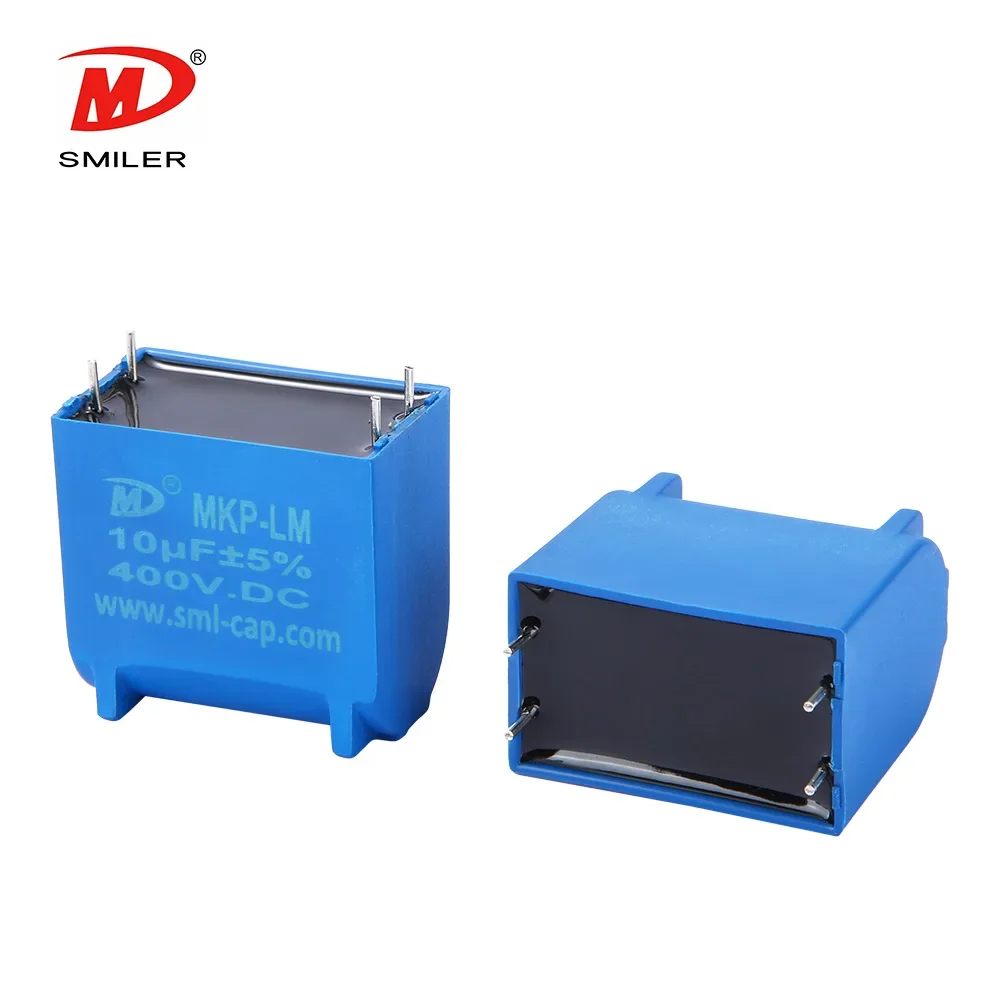
Electrolytics top out around 500–600 V DC per can, so high-voltage DC links need series stacks with balancing resistors. Film capacitors scale higher in a single unit. SMILER's MKP-LL series covers 600 V DC to 4000 V DC (the 4000 V DC figure is the maximum range; typical solar and drive applications sit at 600–1500 V DC), with capacitance from 24 µF to 5600 µF. The MKP-LM series covers 500–1200 V DC with 1–110 µF in a PCB-mount flame-retardant plastic case (UL94 V-0).
Form factor matters too. Electrolytics are bulky cylinders that eat board space and complicate thermal management. Film capacitors come in aluminum cans (MKP-LL) or compact plastic housings (MKP-LM) that mount cleanly on a PCB or busbar. The MKP-LM THB-Type uses a PPS high-temperature housing for harsh humid environments, tested to 1000 hours at 85°C/85% RH with rated voltage applied and capacitance change within 10%.
Specification Comparison: MKP-LL vs MKP-LM vs Electrolytic
| Parameter | MKP-LL (Film) | MKP-LM (Film) | Aluminum Electrolytic (typical) |
|---|---|---|---|
| Dielectric | Metallized polypropylene | Metallized polypropylene | Anodized aluminum oxide + electrolyte |
| Voltage range | 600–4000 V DC (max); typical 600–1500 V DC | 500–1200 V DC | Up to ~500–600 V DC per can |
| Capacitance range | 24–5600 µF | 1–110 µF | Wide, but large values need parallel stacks |
| ESR (typical) | Low milliohms at 100 kHz | Low milliohms at 100 kHz | Tens of milliohms at 100 kHz |
| Ripple current | High | High | Moderate; derate heavily near limits |
| Self-healing | Yes | Yes | No |
| Lifespan | 100,000 h at rated voltage, 70°C hot spot | 50,000 h at rated voltage, 85°C | ~10,000–20,000 h, strongly temperature-dependent |
| Operating temperature | Climate category 40/85/56 | -40°C to +85°C; derate 1.33%/°C up to 105°C | Typically -40°C to +105°C, but life drops sharply |
| Polarity | Non-polarized | Non-polarized | Polarized |
| Failure mode | Open or graceful degradation | Open or graceful degradation | Short, vent, or dry-out |
Total Cost of Ownership in Real Systems
Electrolytics win on unit price. Film capacitors cost more upfront, sometimes two to three times more for equivalent capacitance. But that's the wrong comparison. Look at the whole system.
In a solar inverter, an electrolytic bank might need replacement every 7–10 years, while the panels are warrantied for 25. That's a field service visit, labor, and downtime. Film capacitors rated for 100,000 hours at 70°C can outlast the inverter enclosure. Add the smaller heatsink, fewer parallel strings, and simpler busbar layout, and the film solution often closes the gap on total cost.
In VFDs, the same logic applies. A drive that runs 24/7 in a factory sees electrolytic dry-out as a predictable maintenance item. Film capacitors remove that from the maintenance schedule. For EV chargers, where uptime directly affects revenue and customer satisfaction, the reliability premium is easy to justify.
You can explore SMILER's MKP-LL DC-link capacitor series for high-power aluminum-can designs, or the MKP-LM DC-link capacitor series for compact PCB-mount and THB-type options. For application-specific guidance, the solutions page covers solar, EV charging, industrial drives, and HVAC.
When Electrolytics Still Make Sense
Don't write off electrolytics entirely. In low-cost consumer electronics, short-life products, or space-constrained designs where the DC-link ripple is modest, an electrolytic can be the rational choice. The key is matching the technology to the mission profile. If your product needs 5 years of life at 40°C ambient with gentle ripple, an electrolytic will do the job at lower cost. If you're designing for 15 years in a solar farm or a 24/7 factory drive, film is the safer bet.
Frequently Asked Questions
Can I directly replace an electrolytic capacitor with a film capacitor?
Not always directly. Film capacitors typically have lower capacitance per unit volume, so you may need a different value or a parallel bank to match the original energy storage. Check the voltage rating, ripple current, and mounting. The good news is that film capacitors are non-polarized, so you don't have to worry about reverse installation.
What certifications should I look for in film capacitors for power electronics?
Look for IEC 61071 for DC-link and power electronic capacitors, and IEC 60384-14 for EMI suppression types. SMILER operates under ISO9001:2005 and holds TUV (R 50352497 0002), VDE (40034278), CB (CN36735, CN65200), LVD (AN 50706408 0001), and RoHS (CANEC26003636901) certifications; note that the TUV and VDE certificates specifically cover AC motor capacitors, and the CB certificates cover AC motor capacitors and CBB61 series, so confirm the scope matches your application. The MKP-LL and MKP-LM series are designed to GB/T 17702 (IEC 61071).
How does self-healing actually work in a metallized film capacitor?
The metal electrode is vapor-deposited directly onto the polypropylene film, only nanometers thick. If a local dielectric breakdown occurs, the energy of the fault vaporizes the metal around the site, isolating the defect. The capacitor loses a tiny fraction of its capacitance but continues to operate. This is why film capacitors fail gracefully rather than shorting.
Related Capacitor Series
Need Datasheets or Custom OEM Film Capacitors?
Send your capacitance, voltage rating, and mechanical drawing. Our 9-member engineering team replies within 24 hours with 5-day prototyping availability.